If you're planning a trip to South Korea, you've probably wondered about Seoul's sights, right?!
Well, what I can tell you is that Seoul is an impressive city full of attractions! I confess I wasn't expecting much, but it surprised me a lot. But be prepared to take an organised itinerary, because the city is huge (605.21 km² and 9 to 10 million inhabitants) and the attractions are very spread out.
To make the most of your visit, it might be worth renting a place right in the heart of Seoul. This way, you'll be closer to the attractions you want to visit. One option is booking one of the many Seoul apartments on www.seoulhotelspage.com.
Known all over the world and surrounded by mountains, this metropolis has a history of more than 2,000 years, as well as five UNESCO World Heritage Sites.
Here are some of the recommended things to do in Seoul.
Seoul sights: what to do
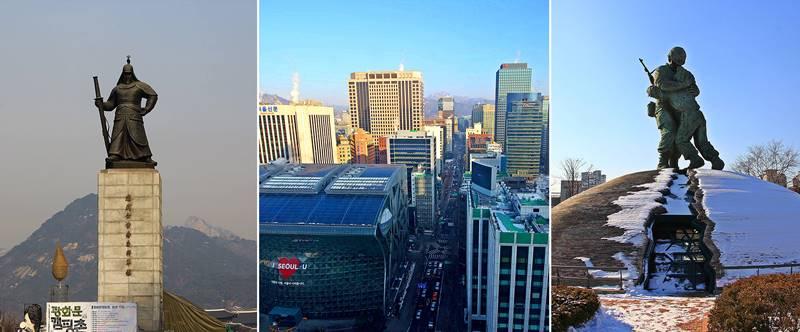
Here's everything there is to do in Seoul
1. N Seoul Tower
There's not much mystery about this tower, still known as the Namsan Tower or Seoul Tower, because the name itself partly tells you what it's all about: the tower that transmits the signal from Seoul to the media in the whole of South Korea.
The N Seoul Tower offers a 360-degree view of the city and is a postcard of the capital.
Apart from that, it's also known for the padlocks left on it by couples and friends. Thousands of them!
It's a great place to take photos, we conclude, and it's also possible to put your own padlock on it, whether you buy it there or somewhere else cheaper.
Address: 105 Namsangongwon-gil, Yongsan 2(i)ga-dong, Yongsan-gu
Openinghours: open every day from 10am; on Saturdays, the observatory closes at midnight.
Price: 10,000 won (around US$9)
How to get to N Seoul Tower: underground to Myeongdong station (line 4) - exit 3. When you get off, walk for about 10 minutes up the street from the Pacific Hotel.
=> Read also:
Seoul tips (your complete guide)
South Korean cities

2. Bukchon Hanok Village
As we said at the beginning of this article, one of the tips in Seoul involves discovering its ancient history.
The Bukchon Hanok Village, with its traditional houses that, during the Joseon Dynasty, served as a residence for government officials, stands out among the possibilities.
Today, with its many staircases and hillsides preserved, Bukchon Hanok Village is also known for its art galleries, restaurants and tea shops.
However, despite this tourist and commercial aspect in general, many families have not ceased to live in this village, and it is common to find house doors with requests for silence.
It's interesting to observe this world apart, calm and traditional, in the midst of the "madness" that is Seoul.
How to get to Bukchon Hanok Village: underground to Anguk station (line 3) - exit 2
3. Gyeongbokgung Palace
With a long history of successive constructions and destructions, this palace (gung), "greatly blessed by heaven" (Gyeongbok), bears the marks of the various moments experienced by South Koreans over the last few centuries.
It was first built in 1395, but was soon burnt down and forgotten for almost 300 years.
In 1867, when it was finally rebuilt by the then ruling Joseon Dynasty (1392-1897), it became the largest of the palaces, the main one among the "Five Great Palaces".
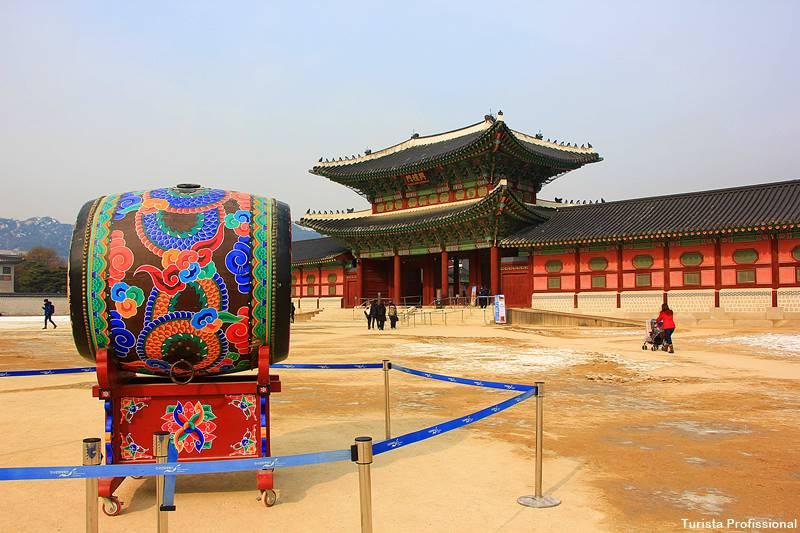
One of Seoul's main tourist attractions
However, the palace was destroyed again at the beginning of the 20th century by Japan. From then on, until it reached the state it is in today, the palace complex, which is entirely surrounded by walls, was restored to its original form.
During your visit you'll see a lot of people there, usually women, wearing typical Korean costumes, as this is the perfect place for photo shoots.
Address: 161 Sajik-ro, Sejongno, Jongno-gu
Openinghours: Every day except Tuesdays, from 9 a.m. to 6 p.m.
Price: 10,000 won (about US$9)
How to get there: metro to Gyeongbokgung station (line 3) - exit 5
4. Changdeokgung Palace
Among the many tourist attractions in Seoul, we couldn't fail to mention this palace complex, which is also very important in the history of the city and the country as a whole, and which has been a UNESCO World Heritage Site since 1997.
As I said, it consists of a group of palaces located in a large park in Seoul and, like Gyeongbokgung Palace, it is also one of the five great palaces built by the aforementioned dynasty.
Given its location to the east of Gyeongbok Palace, it can also be known as the "Eastern Palace".
Address: 99 Yulgok-ro, Waryong-dong, Jongno-gu
Opening hours: Every day from 9am to 5pm; closed on Tuesdays
Price: 10,000 won (about US$9)
5. Insadong
When wondering what to do in Seoul, a visit to Insadong is always recommended.
This is because it's an area with several interesting streets, where you'll find a number of teahouses and traditional Korean restaurants.
It's also a great place to buy traditional Korean products, some of which are made from ceramics, as well as tea, Korean handmade paper (hanji) and lots of souvenirs.
How to get to Insadong: metro to Anguk station (line 3) - exit 6
6. Lotte World
It's not uncommon for tourists to decide to go to Disney when they visit the USA. In the case of Seoul, we have Lotte World, known as the Korean version of this park, with a castle.
In addition, this park obviously contains several rides, both indoor and outdoor, as well as underground rides. Legend has it that it is the largest indoor park in the world.
It was a trip we took with our daughter, who was 2 at the time, and we really enjoyed it - and so did she! ???? By the way, there are many parks in South Korea that are worth visiting.
This same park is also home to the fifth tallest building in the world, the Lotte World Tower.
Address: 240 Olympic-ro, Jamsil-dong, Songpa-gu
Openinghours: Every day from 9.30am to 10pm
Price: 57,000 won (around US$ 50)
How to get to Lotte World: metro to Jamsil station (lines 2 or 8) - exit 4
7. Namdaemun Market
Among the many attractions in Seoul, one that could be well worth a visit is this market, which is the largest in the city.
It's full of typical products - which we have no idea what they are, lol - clothes, electronics and, if you like to see - and try - street food, you're in for a treat.
What's more, Namdaemun Market is close to the main gate of the southern part of older Seoul, known as Sungnyemun.
Address: 21 Namdaemunsijang 4-gil, Hoehyeon-dong, Jung-gu
Openinghours: Visit during typical business hours
How to get to Namdaemun Market: underground to Chungmuro station (line 3 or 4)
8. Cheonggyecheon
In a nutshell, this attraction is a stream whose waters were once unseen because they were under concrete and polluted, as they were part of the sewage system.
It has undergone a major revitalisation and has now become one of Seoul's main postcards.
The revitalisation began in 2003 and today the water there is crystal clear with little fish.
The place is beautiful and perfect for a walk. It's not uncommon to find street performers there.
9. Myeongdong
You may not know it, but South Korean cosmetics are highly celebrated, so if you're a fan of this type of product, passing through Myeongdong is the best choice.
As it's one of the city's biggest shopping streets, full of people and illuminated billboards, you'll also find lots of street food, the country's traditional snack stalls.
If you want to see this street at its best, go at night, when all the signs are up and the street is buzzing!
How to get there: metro to Myeongdong station (line 4)
10. Gangnam
Anyone planning a trip to Seoul is sure to have heard the song "Gangnam Style", famous all over the world thanks to the singer Psy.
And if you take the song as a reference, you won't be wrong, because this is an area of the city that really is the centre of luxury brands and nightclubs, as well as big companies.
The neighbourhood is a little further away, but it's worth a visit.
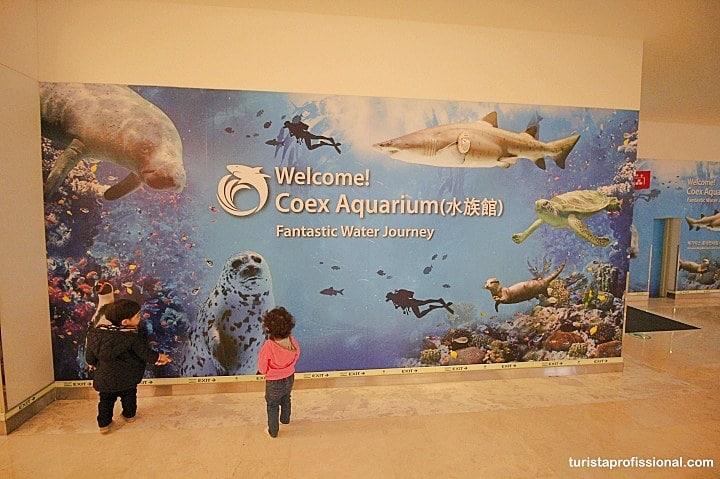
As well as Lotte World, which is in the neighbourhood, you can also visit the WTC, COEX Mall, the Seoul Aquarium (which is inside this mall) and the Bongeunsa temple.
How to get to Gangnam: metro to Samseong station (line 2)
11. Korean War Memorial
Built on the site of the South Korean army's headquarters, this is a free museum whose main purpose is to exhibit a remarkable part of the country's history: the Korean War. It is one of Seoul's major tourist attractions.
The War Memorial is full of armoured vehicles, missiles, weapons and aircraft, all displayed in the open air as a reminder of the war.
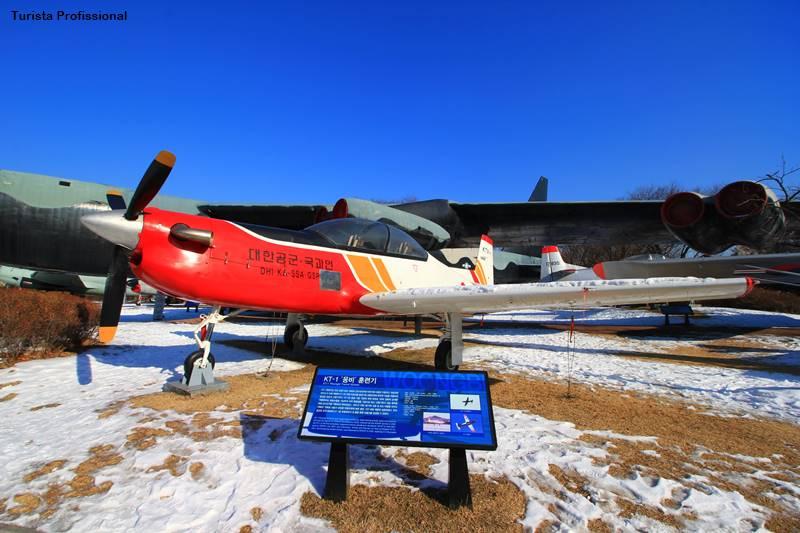
There is also a strong emphasis on information, with infographics and videos explaining the conflict.
Even if you don't enter the museum, a visit to the armoury outside is well worth it!
Address: 29, Itaewon-ro, Yongsan-gu
Openinghours: Tuesday to Sunday, 9.30am to 6pm
Price: Free
How to get there: underground to Samgakji station (line 6) - exits 1, 11 or 12. Or underground to Namyeong station (line 1) - exit 1
12. National Museum of Korea
Of all Seoul's attractions, this is certainly a must-see.
Located right in Yongsan Family Park, this museum is the most important in the country, and not just because it has over 200,000 exhibits, but mainly because it is the sixth largest in the world and has architecture that, although modern, was inspired by ancient Korean fortresses.
You only have to see it in person to realise how grand it is in every way.
Address: 137 Seobinggo-ro - Yongsan-gu
Opening hours: Wednesday and Saturday, 10am to 9pm; Sunday, 10am to 7pm; other days, 10am to 6pm.
Price: Free
How to get to the National Museum of Korea:metro to Ichon station (line 4) - exit 2
13. Dongdaemun Design Plaza
This was one of the places I most enjoyed visiting in the city and here's a tip: go there by day AND by night, as it takes on a whole new charm when lit up at night!
It's a super futuristic building, ideal for those who love architecture and photography, because it's super photogenic.
Inside, among the shops and restaurants, there is the Design Museum and the Design Market, unmissable places for those who want to experience cutting-edge technology.
How to get there: underground to Dongdaemun station (lines 1 or 4) - exit 8
14. Tour to the DMZ
Anyone who visits South Korea may at some point have the idea of trying to visit, if not North Korea, at least the Demilitarised Zone (DMZ), i.e. the border between these two brotherly, albeit rival, countries.
This is one of the most fortified borders in the world, due to the constant tensions between the two or between North Korea and the USA, a major ally of South Korea.
North Korea isn't inaccessible to tourists, but it's a bit complicated because of all the security situations.
We've never tried to go there, but at least this border can be easily explored on so-called DMZ Tourswhich cost an average of U$50 per person.
Of course we went! ????
One of the great tourist attractions in South Korea
The tours leave from Seoul, 1.5 hours away. Transiting between the two Koreas, within the DMZ, is only possible, however, in the small conference room of the Joint Security Area (JSA), the place where the Armistice Agreement was signed in 1953.
But on the tour you can see the border itself, the flags of the two countries and even visit an old military tunnel that joined the two countries underground.
Flag of North Korea
Do you think the list of things to do in Seoul is over?
Certainly not.
There are still lots of other sights to see in Seoul, but even though we spent almost a week there, we didn't manage to see everything, which is a great excuse to come back, lol.
Have a good trip!
Reasons to visit Turkey in winter
La Pedrera Uruguay: how to get there and what to do