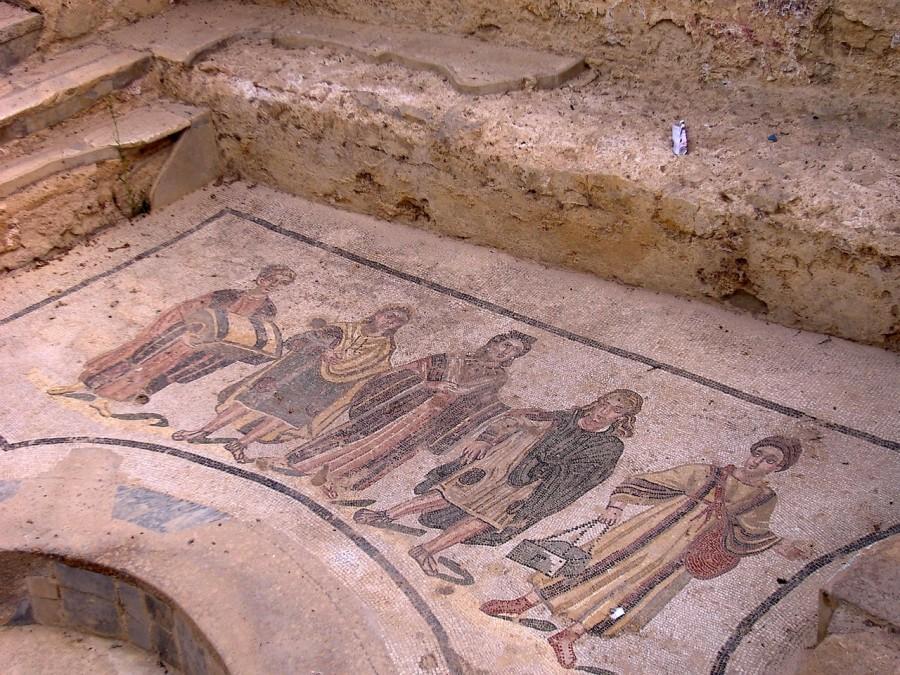
 Located exactly in the centre of Sicily, 30 minutes from Enna, Piazza Armerina today forms part of the tourist district of Caltagirone together with Aidone and the site of Morgantina. The origins of the city are very old: the area was already inhabited by the Greeks, perhaps from Gela. Then came the Romans, who left us the splendid Villa Romana del Casale, one of the most famous and admired Roman buildings in the world with its mosaics.
Piazza Armerina has one of the largest and richest historical centres in Sicily, but unfortunately it often takes second place to larger and more famous cities. Suffice it to say that in 1512, Charles V awarded it the title'Urbs Opulentissima.
Here is an itinerary of the 10 things to visit in Piazza Armerina in a weekend.
What to see in Piazza Armerina in a weekend
1 - Cathedral Maria Santissima delle Vittorie
 Photo by Carlo Pelagalli. The Cathedral of Piazza Armerina is a colossal building that stands on the highest point of the city, in the heart of the Monte district. It took more than a century to build it (from 1604 to 1719). Dedicated to Maria Santissima delle Vittorie, the Cathedral is characterised by an architecture that is a mixture of styles ranging from Gothic to Baroque, as well as a 40-metre-high bell tower in Catalan-Gothic style that dates back to the previous church that stood on this very spot.
The exterior is made of sandstone, which with its characteristic yellow colour allows its gigantic aqua-green dome (the highest in Sicily at 76 metres high) to stand out even more, even from miles away. Inside, you can see a wooden cross, painted on both sides depicting the crucifixion and resurrection of Christ, a baptistery made by Antonello Gagini and the silver high altar containing the icon of the Madonna delle Vittorie, which is carried in procession every 15 August.
How to get there: Piazza Cattedrale. By car from Piazza Garibaldi take Via Camillo Benso Conte di Cavour to Piazza Cattedrale. On foot take the same route - Get directions
Info: free/visit depending on Mass times
2 - Trigona Palace
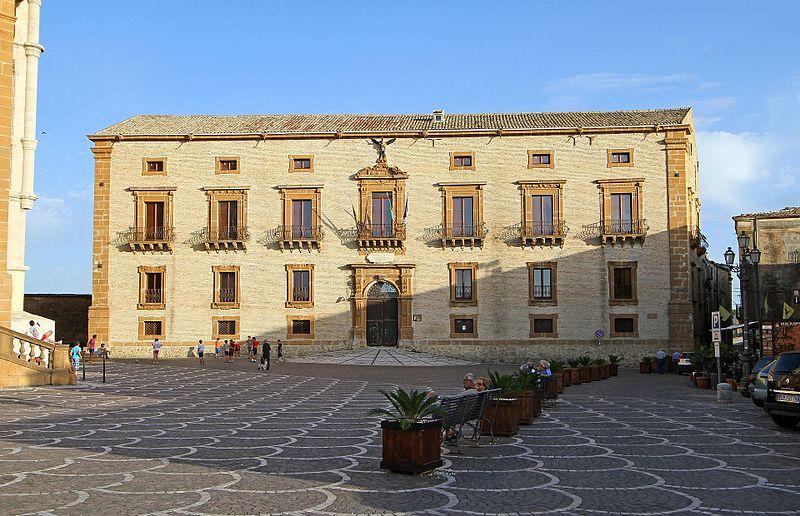 Photo by Carlo Pelagalli. Palazzo Trigona della Floresta is located a few steps from the city's cathedral. The wish to build this palace was expressed by Matteo and Ottavio Trigona in 1690 during the reign of King Martin I. There is no certain information on who drew up the initial plan, but certainly the architect Orazio Torriani, who was also in charge of the neighbouring cathedral, was actively involved in choosing certain aspects of the palace.
Its three floors conceal a large inner courtyard, while on the central balcony you can see the Trigona family coat of arms. After years of work, the Trigona palace is now ready to house the city's Archaeological Museum.
How to get there: Piazza Cattedrale. By car from Piazza Garibaldi take Via Camillo Benso Conte di Cavour to Piazza Cattedrale. On foot take the same route - Get directions
Info: 0935 687667
3 - Aragonese Castle
The Aragonese Castle is located on the southern slope of Mount Mira. Built in the 14th century during the reign of King Martin I the Younger, it has an imposing structure, characterised by mighty walls and four angular towers. If you can't find the entrance, don't worry, the courtyard and main entrance are in fact on the opposite side of the square, to the south.
Over the centuries, this building, which initially had a defensive purpose, passed through various hands until it became a prison in 1812, as the iron windows still testify. Remaining in the hands of a private citizen for years and in a state of near-abandonment, the castle has now been purchased for restoration. It is nevertheless a building much loved by the inhabitants of the city, who stage various historical plays and neighbourhood festivals here, especially in the summer months.
How to get there: Piano Carcere 11. By car from Piazza Garibaldi take Via Camillo Benso Conte di Cavour to the Cathedral and continue along Via Floresta. On foot from Piazza Garibaldi take Via Vittorio Emanuele - Get directions
Info: Currently only visitable from the outside unless there are performances taking place
4 - Church of San Rocco
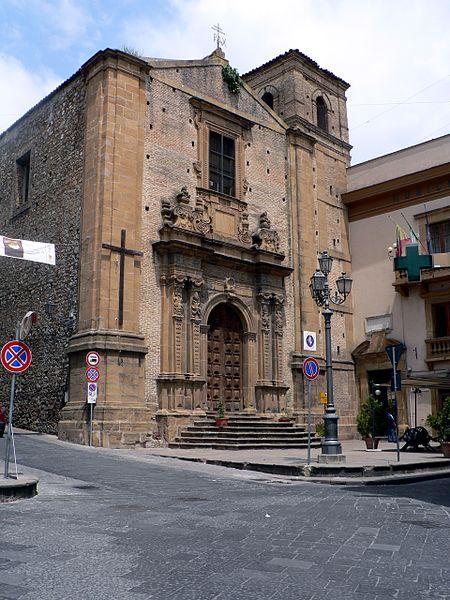 Photo by Maxkool1980. The Church of San Rocco is also known by the inhabitants of Piazza Armerina as'Fundrò'. This nickname goes back to the very origins of the church: Fundrò was a rural village about ten kilometres from the city, where there was a church and a convent with Benedictine monks. After the destruction of the village at the end of the 14th century, the monks took refuge in Piazza Armerina and here they were entrusted with the church of San Rocco. Also the work of the Benedictines is the convent that is still adjacent to the church and houses the town's municipality.
Outside the church you can admire its yellow tufa façade, while inside there are paintings from the 17th century and a marble Madonna from the ancient abbey of Fundrò. When you visit it, look at the façade: near the portal you will see a sundial, which still tells the time to those in the square. Curious note: the church has a kind of 'twin' in the square: the town hall on the other side of the pavement. At first glance, the two buildings look very similar.
How to get there: Piazza Giuseppe Garibaldi. By car from Piazza Generale Cascino take Via Monsignor Sturzo and turn onto Via Roma. Follow it to Piazza Giuseppe Garibaldi - Get directions
Info: free, according to Mass times
5 - Church of San Pietro
The Church of San Pietro is certainly one of the most important religious buildings in the city. The complex, comprising the church and a convent, was built around the middle of the 16th century to honour a miraculous image of the Madonna located in a small church that stood there. The exterior of this church, called the'Pantheon of Piazza Armerina', is quite bare, while its interior, with a single nave, is rich in masterpieces. Starting with the decorated coffered ceiling that creates a very special optical effect, to the gigantic canvas on your left, possibly the work of Caravaggio or his school.
In the area of the apse, you can then see the famous miraculous icon of the Madonna and, on the opposite side, what used to be the ancient apse of the small church that stood there before St Peter's was built.
Once you have visited the interior of this church, you can then enter the 16th-century cloister of the convent. In this courtyard, you will not even feel like you are in the city.
How to get there: Viale Generale Ciancio 2. By car from Piazza Giuseppe Garibaldi take Via Umberto I to Piazza Generale Cascino. Proceed along Viale Generale Ciancio to your destination - Get directions
Info: free. Can be visited according to Mass times
6 - Garibaldi Theatre
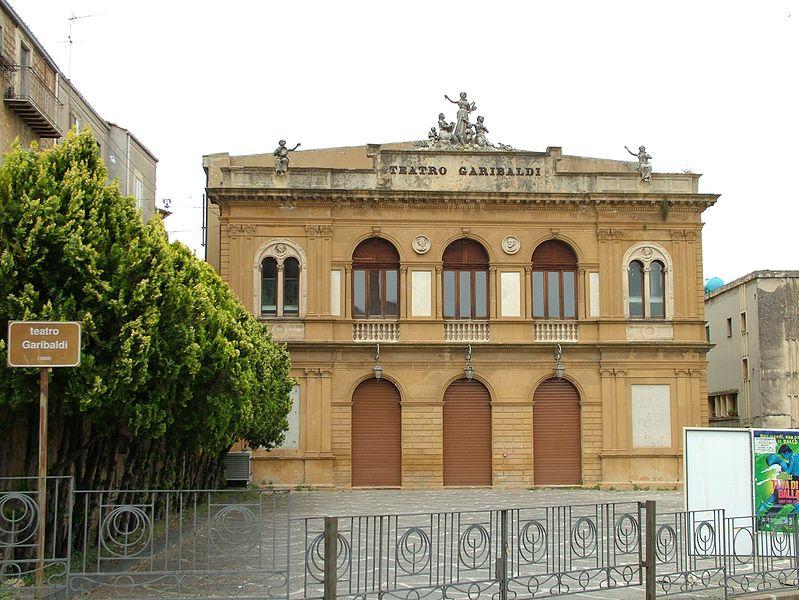 Photo by Clemensfranz. The municipal theatre is located opposite the Church of Santo Stefano. Dating back to the 18th century, this theatre with a total of 320 seats, divided between stalls, three tiers of boxes and a gallery, is one of the oldest municipal theatres in all of Sicily. Today, cultural events and film screenings are organised here, but this does not detract from the beauty of this building.
The ceiling of the theatre, when the entrance was built in the early 20th century, was completely frescoed by Giuseppe Paladino. The façade is decorated with bas-reliefs depicting the faces of Alfieri, Bellini, Goldoni and Verdi.
How to get there: Piazza Umberto I. By car from piazza Giuseppe Garibaldi take via Umberto I to piazza Umberto I, near the church of Santo Stefano - Get directions
Info: free. Can be visited according to show times
7 - Commandery of the Knights of Malta
The Commenda dei Cavalieri di Malta is very close to the Garibaldi Theatre. Built in the 12th century, it was originally intended to serve as a 'hospital' for crusaders travelling from Sicily to Jerusalem. This building was located outside the city walls at the time, whereas today it is a stone's throw from the Municipal Theatre and the 'modern' city centre. Inside, there is not much to see: the church is decidedly bare, but it is certainly one of the most fascinating places in the city.
How to get there: Piazza Umberto I. By car from Piazza Giuseppe Garibaldi take Via Umberto I to Piazza Umberto I, at the Church of Santo Stefano - Get directions
Info: free, depending on Mass times.
8 - Fountain of the Canals
This is the most important fountain with drinking trough in the entire city and is also the most frequently visited. Located in the heart of the Canali district and built in the 19th century, the Canali fountain comprises four masks from which spring water flows at all times of the day, a drinking trough and also a wash-house with more than 20 'stations'.
To date, it is not known who the four masks are supposed to represent: some say they are supposed to be the four Dello Spedale brothers, who were commissioned to sculpt them. Others say they should represent four important men of the Risorgimento: Mazzini, Camillo Benso Count of Cavour, Vittorio Emanuele II and Giuseppe Garibaldi. This second option, given the period in which the fountain was built, seems more plausible. Moreover, to think that even today citizens still fetch water from Vittorio Emanuele II is quite amusing.
How to get there: Via Zaffiro. From Piazza Giuseppe Garibaldi, take Umberto I to Piazza Generale Cascino. Head for Via Monsignor Sturzo and turn onto Via Principato. Proceed along Via Giacomo Matteotti as far as Largo Conceria - Get directions
Info: free, always visitable
9 - Villa Romana del Casale
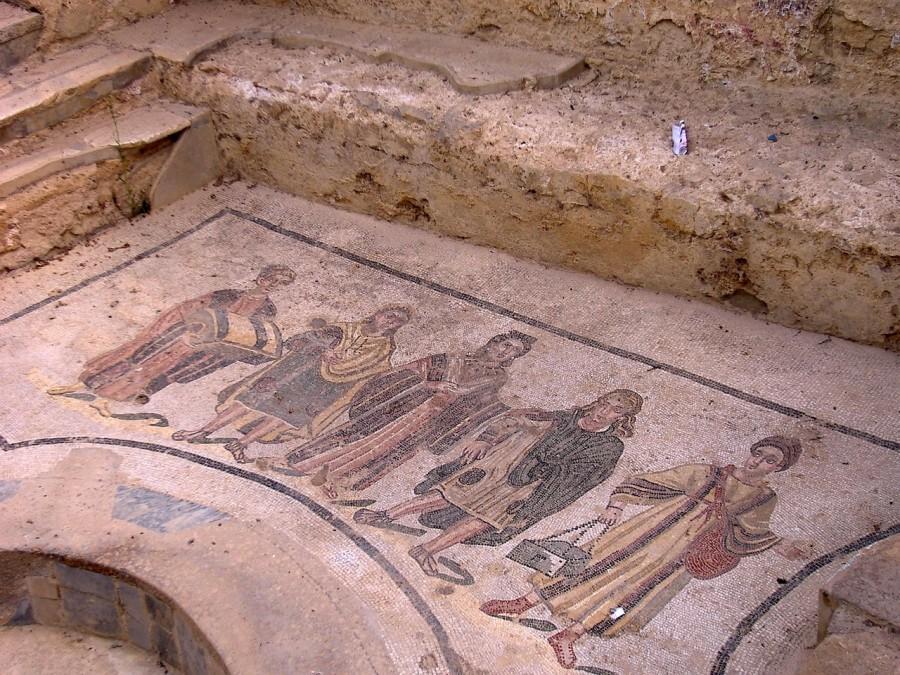 The Villa Romana del Casale is undoubtedly the city's main attraction and one of the most important sites in the whole of Sicily.
Consisting of 60 rooms and 3,500 square metres of floors entirely made with the mosaic technique, this villa has been a UNESCO World Heritage Site since 1997. It is precisely in this villa that the famous mosaics of the'bikini girls', as well as the scenes of the 'great hunt' and the'erotic scene' can be found.
Its discovery took place in 1950 and since then work has been going on to bring its entire surface to light, although recently the remains of an adjacent medieval village have also been found.
The Roman Villa del Casale probably dates back to the 4th century, but the name of the owner is not known. Given the presence of numerous mosaics depicting animals and hunting scenes, it has been speculated that it might have been owned by one of Rome's many exotic animal traders.
There are four different nuclei that make up the villa: a monumental entrance, the villa proper with its mosaic-rich rooms and peristyle, a trichora and even a bath complex. If you have the chance, visit it also in the evening, when the villa is the venue for musical and artistic events.
How to get there: SP15 in the direction of 'mosaics' and 'Villa Romana del Casale' - Get directions
Info: admission €10.00 / open daily from 9:00 a.m. to 6:00 p.m.
10 - Villa of Wonders
This villa, not far from the Villa Romana del Casale, is home to one of the most important 'private' museums in the area. This splendid 18th-century villa houses the collection of the Cammarata family.
The brainchild of Enzo Cammarata, in this museum you can see historical artefacts of all kinds: period vases, ceramics, inlaid furniture, paintings, sculptures (including one possibly made by Michelangelo), marbles, and anything else that could possibly cross your mind.
How to get there: SP15 in the direction of 'mosaics' and 'Villa Romana del Casale'. When you reach the junction for the Villa proceed to the right and follow the signs for "Villa delle meraviglie" - Get directions
Info: admission €4.00 / open Mon-Sun 9:00 - 19:00
One-day itinerary in Piazza Armerina
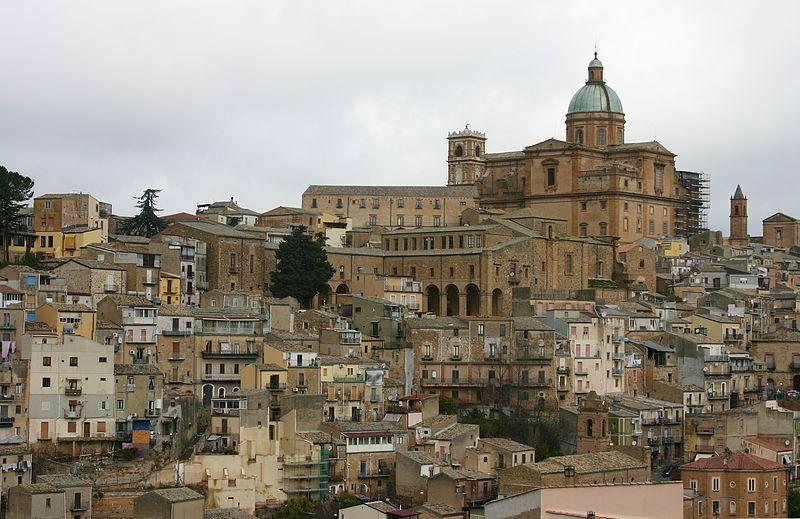 Photo by José Luiz. If you want to visit Piazza Armerina in one day, you need to take into account a few basic things, which mainly concern transport in the city and the location of the most interesting sights. Top priority is the historic centre.
We also suggest a full-day visit with a local guide, who will guide you through the best sights and highlight the history and peculiarities of the town (from €90.00 - book online)
In the morning, we visit the historic centre.
We start from Piazza Giuseppe Garibaldi, the old heart of the city from which the four neighbourhoods originated; breakfast at the Caffè del Centro and a visit to the Church of San Rocco and then climb up to the Cathedral and admire (from the outside) Palazzo Trigona and the Aragonese Castle.
The afternoon is dedicated to the Villa Romana del Casale.
Return to Piazza Garibaldi and, after lunch at Totò's, take Via Roma to 'descend' to the Canali.
After seeing the fountain with the four masks, head to the Villa Romana del Casale.
In the evening, stroll around Piazza Cascino.
Treat yourself to a stroll at'Cascino', the main square of the city where there is a monument dedicated to General Cascino. Here there are shops and all kinds of refreshments.
If you want to try something 'typical', try the arancine and rustic specialities of the Red Dragon, one of the city's best known places, strictly to be eaten while strolling. If, on the other hand, you have some time on your hands, head to the Santa Croce area and dine at Da Elide (the pizzas are highly recommended). With a full belly, you can then go 'al Cascino' and have a nice walk to end your day in Piazza Armerina.
At a glance
Breakfast at the Caffè del Centro
Church of San Rocco
Cathedral
Fountain of the Canals
Villa Romana del Casale
Lunch at Ilia's
Church of San Pietro
Dinner at Toto'
Monument to General Cascino
Where to Eat
Piazza Armerina offers little joys to lovers of good food with real delicacies, ranging from breakfast to dinner, not forgetting snacks for the sudden hunger that may seize you during your stay.
Breakfast: Caffè del Centro, Piazza Giuseppe Garibaldi. Tel: 0935 686577 - Get directions
Lunch: Da Elide, Via Leonardo da Vinci. Tel: 0935 682610 - Get directions
Dinner: Da Totò, Via Mazzini, 29. Tel: 0935680153 - Get directions
Plan your visit to Piazza Armerina: info and advice
How to get around: to move between the various attractions, you can go either on foot or by car, since the places we are going to discover are quite close to each other. There is public transport but it is very limited, so it is better to go on foot and use your own vehicle for longer trips.
Where to park: if you don't know where to park, the city is also well provided with free parking areas where you can leave your vehicle without any problems.
Where to stay: Hotels and b&b from €42.00 per room - see offers
What to see nearby: Enna (33 km), Caltagirone (26 km), Aidone (12 km), Pergusa (26 km), Caltanissetta (41 km)
Card, tickets and recommended tours:
Curiosity: the Palio dei Normanni
The Palio dei Normanni is held every 13 and 14 August in the city. During this historical (and sporting) event, which retraces the time of Norman domination in Sicily with Count Roger, the four quarters of the city compete to determine the winner who will have the honour of holding the banner of Maria Santissima delle Vittorie, the city's patron saint, until the following year. Should you happen to be in Piazza Armerina be sure to go to the Piano di Sant'Ippolito to see the joust, it will be spectacular.