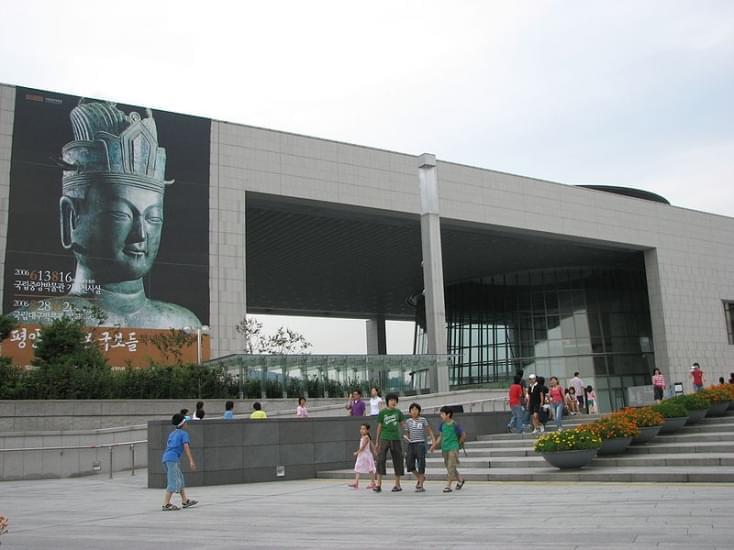
 After changing locations several times over the years, the Seoul National Museum found its final home in the beautiful new building in Yongsan Park in 2005. Today, it is the largest art museum in South Korea and the sixth largest in the world with an area of 137,201, also being one of the most visited museums in the world. Due to its exhibition and educational offerings, it is very popular with the inhabitants of the Korean capital, who visit the museum frequently throughout the year.
With so much to explore and experience, it is recommended to plan a dedicated trip for the museum. And what's more fulfilling than to couple it with a luxurious stay? Treat yourself to one of the5 star hotels in Seoul on www.seoulhotelspage.com during your visit to make the most of your trip. After all, nothing complements an enriching day at the museum like unwinding in a lavish suite with top-notch amenities.
After changing locations several times over the years, the Seoul National Museum found its final home in the beautiful new building in Yongsan Park in 2005. Today, it is the largest art museum in South Korea and the sixth largest in the world with an area of 137,201, also being one of the most visited museums in the world. Due to its exhibition and educational offerings, it is very popular with the inhabitants of the Korean capital, who visit the museum frequently throughout the year.
With so much to explore and experience, it is recommended to plan a dedicated trip for the museum. And what's more fulfilling than to couple it with a luxurious stay? Treat yourself to one of the5 star hotels in Seoul on www.seoulhotelspage.com during your visit to make the most of your trip. After all, nothing complements an enriching day at the museum like unwinding in a lavish suite with top-notch amenities.
What to see and how to visit National Museum of Korea
The museum houses over 220,000 objects, of which 13,000 are on permanent display. Some rooms are dedicated, on a rotating basis, to temporary exhibitions, for which an entrance fee may be charged depending on the importance. The exhibitions are always of a high standard and range from photography, sculpture, painting, visual arts and modern works. The permanent collection is divided into three distinct floors, to which at least 45 minutes should be devoted each.
On the first floor is the archaeological gallery, which houses some 4,500 exhibits ranging from the Palaeolithic period to the period of the unification of Silla, one of the three kingdoms once a confederation of states unified by King Park Hyeokgeose, and the historical gallery. The floor is in turn divided into two different sections: the first section contains evidence of the Goryeo dynasty (918-1392), the Joseon dynasty (1392-1897) and the imperial period (1897-1910); the second section contains the prehistoric period and the ancient history, up to the year 1000, of the entire region.
On the second floor is a gallery housing 890 pieces of Korean religious and traditional art and works from different cultures, also divided into two sections. The first section features calligraphy and beautiful examples of traditional Korean and Buddhist painting, while the second houses collections donated to the museum by private individuals and also relating to religious and calligraphic arts.
On the third floor are handicrafts and sculptures such as the approximately 630 pieces of Korean Buddhist character and over 970 objects of Asian art, and this floor is also divided into two different sections. In the first we find valuable metal and ceramic artefacts as well as religiously inspired sculptures; in the second, works of art from the culture of the entire Asian region.
The museum is completed by a beautiful garden of local plants, water features and meditation spaces.
Following are some of the best pieces on display
1 - Gold Crown (royal crown artefacts)
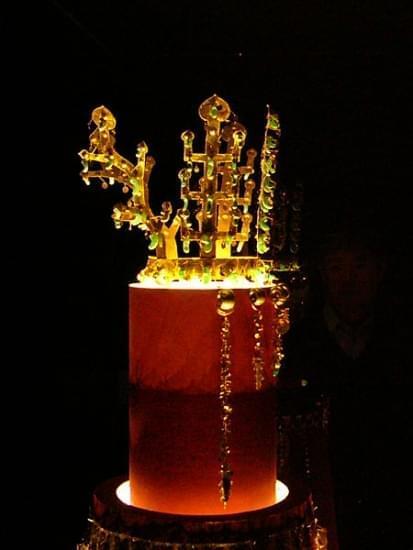 Photo by somedragon2000. Originating from the Beakje region, these ornaments are part of a royal crown dating back to the 6th century. Made of very fine threads of gold, they form a vase of flowers and a lotus blossom. From studies of materials, workmanship and symmetries, it would appear that they were part of a queen's crown.
2 - Horse Rider and Servant
Pair of 6th century ceramic vessels depicting a servant and his master on horseback. Caste differences can be seen in fine details such as the master's ornaments, while the servant is bare-breasted. The vessels were probably used for serving liquids. Provenance and Gyeongju
3 - Imperial Seal
When King Gojong declared himself emperor in 1897, he decided to change some of the state apparatus and symbols associated with it. Before his inauguration, in fact, the royal seals were in the shape of a tortoise while they were changed to the likeness of a dragon, which Gojong considered to be a more suitable symbol for an emperor. The materials used for this piece on display are ceramic and wood
4 - Bronze Bell
Bronze bell dating from 1010 and from Chungcheongnam-do province. In the Buddhist religion, the sound of bells is auspicious and brings serenity. The bell on display is considered one of the most beautiful of the period and is a masterpiece not only for its sound but also for the finish of its details. It also bears an inscription on its surface indicating where and when it was made.
5 - Pensive Bodhisattva (Buddha)
Besides its historical value, this Buddha statue has great religious value precisely because of the figure it represents. Its contemplative posture and benign, mysterious gaze make it one of the most popular statues in Korean culture. Dating back to the Three Kingdoms period, early 7th century, it is made of ceramic.
6 - Moon Jar (vase)
An 18th century porcelain vase, it is part of a collection called The Moon Jar. It comes from Josoen, made of fine white porcelain, is about 40 cm high and emanates a very bright glow.
7 - Incense Burner
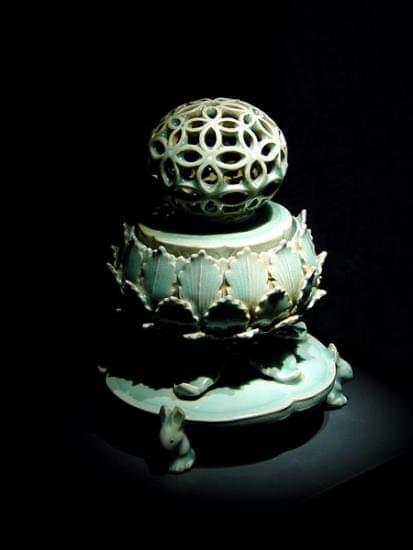 Photo by Steve46814. Another important ceramic artefact from the 12th century, this incense burner is finely decorated and composed of three distinct pieces: an openwork lid from which the smoke came out; the lotus-flower shaped body where the incense was burned; a round base resting on three rabbits. The whole burner is finely decorated by Goryeo craftsmen and the overall aesthetics make it a particularly fine object.
8 - Ferocious Tiger
Dating back to the 18th century, this painting is one of the most beautiful done on this theme. The tiger was one of the protectors against evil spirits and was placed in homes to protect the family. The details highlight the skill of the artist who, in addition to the central body, focused on the details of the tail, the bamboo, the pine trees and the birds in the background.
9 - Portrait of Seo Jiksu (Scholar Portrait)
Dated 1796, this portrait depicts Seo Jiksu with various shading techniques, accentuated by the folds of the garment and the contrast with the off-white socks. The famous scholar's hat and face are also very detailed, highlighting the artist's skill.
10 - Mount Geumgang from Album of Mount Geumgang (landscape painting)
The famous painter Jeong Seon painted a series of nature paintings in 1711, including this beautiful painting of Mount Geumgang. The perspectives emphasise the peaks and the soft colours lead the observer to a state of calm and peace, feelings the artist wished to convey.
Opening times and prices
Hours: Monday, Tuesday, Thursday and Friday from 10 a.m. to 6 p.m.; Wednesday and Saturday from 10 a.m. to 9 p.m.; Sunday from 10 a.m. to 7 p.m.
Best time to avoid queues: the museum is one of the most visited in the world, so you have to anticipate the queue. Best time is during opening hours or in the evenings.
Ticket price: free
AdmissionVariations: A payment may be required at the entrance for temporary exhibitions.
Useful tips for visiting the attraction
Buy thecity card: with the purchase of the Discover Seoul Pass you have free access to many sites in the city, public transport, and discounts at some shops. The cost is KRW39,900 (€30.45) for 24 hours.
Beware of restrictions: no water or food is allowed in the museum and there are also restrictions on the use of photographic equipment. It is advisable to always ask permission from the staff before shooting or filming.
Minimumtime: a minimum of 2 hours is recommended for the visit, bearing in mind that it is always very crowded and there are queues in the various rooms.
Where is it located and how to get there
Onfoot: From Yongsan Station, Seoul's main railway station, it is about 2km by foot in about 45 minutes.
By bus: the museum is served by the local urban bus company with bus line no. 400 or no. 502 at a cost of KRW1250 (€0.98)
By metro: Line 4 or Jungang line, Ichon Station then 150m walk
History and interesting facts: what to know in brief
The museum was opened in 1945 with Emperor Sunjong's collections, but changed its location several times over the years until it was decided to build a purpose-built structure suitable for housing the huge amount of works and exhibits. In 2005 it then found its final home in the modern structure built in the picturesque Yongsan Park. Due to the beauty of the structure and the location, the museum is a destination for Sunday afternoons for many families with children who can find many organised spaces here with workshops, dedicated exhibitions and artistic games. A few years ago, it was decided to set up a children's museum within the structure itself, to which access is free of charge but with an entrance fee precisely to regulate the influx. The Children's Museum is open from 9 a.m. to 6 p.m. and divided into five entrance sessions.